Upcoming Events
Upcoming and past webinars and livestreams
Coming up next
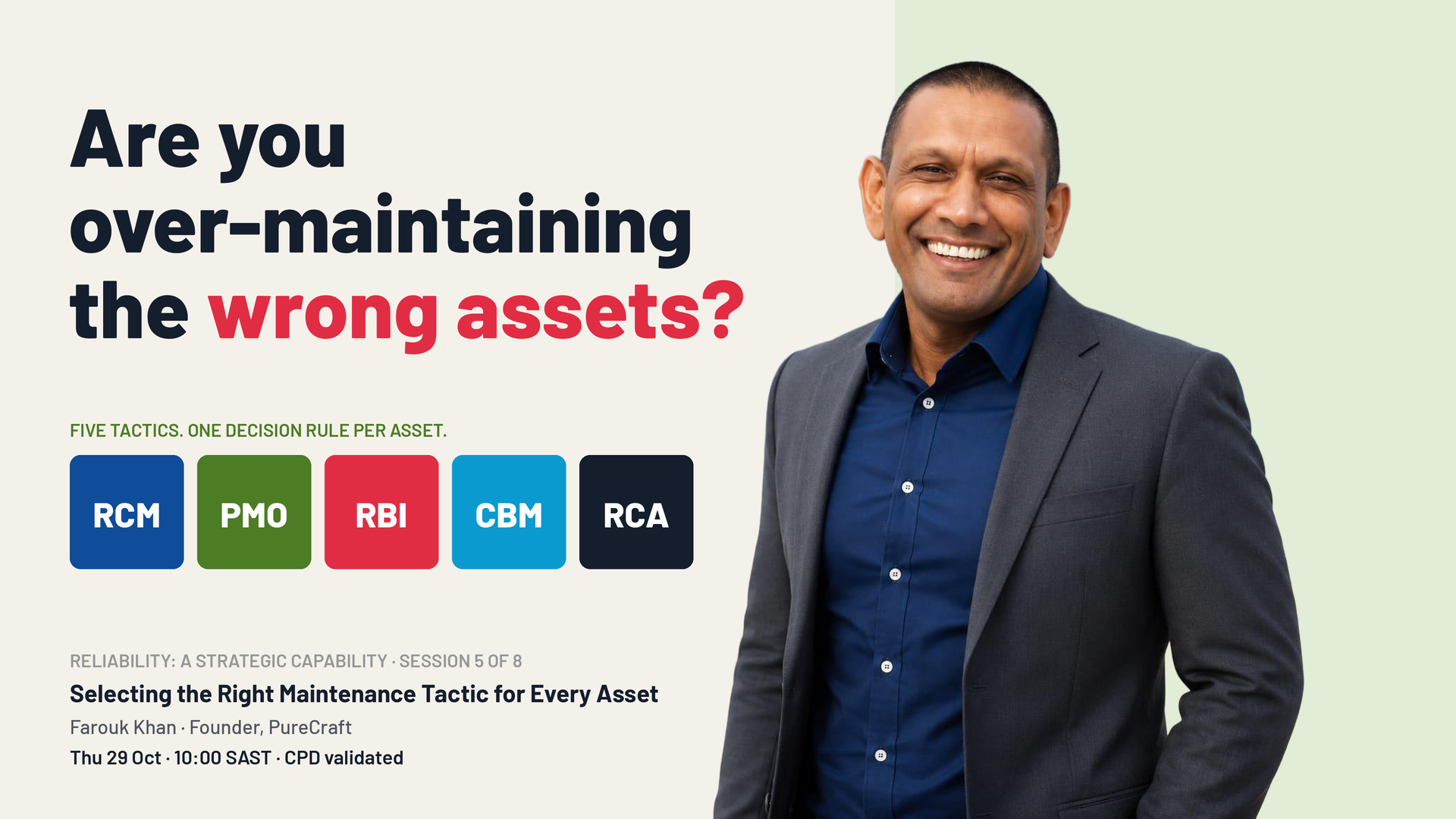
Selecting the Right Maintenance Tactic for Every Asset
Session 5 of 8 · Reliability: A Strategic Capability Choosing a maintenance tactic by gut feel, or "how we've always done it", is how good budgets fund the wrong fixes. Session 5 shows how asset behaviour (static or dynamic) and specific failure mechanisms should decide your tactic, so you can say exactly why each asset gets the one it gets. What you'll learn: - Differentiate maintenance approaches for static containment assets and dynamic functional machinery. - Apply objective decision triggers to choose between RCM, PMO, RBI, RCA and CBM. - Turn condition-monitoring signals into owner-assigned, timely, controlled interventions, not alerts that get ignored. Presenter: Farouk Khan, Founder of PureCraft. When: Thursday 29 October 2026, 10:00 to 12:00 SAST (08:00 GMT, 09:00 WAT, 11:00 EAT). Two hours, discussion-led, with Q&A. CPD validated, live or on demand, certificate on completion. Create your free account, or log in, and book your seat.
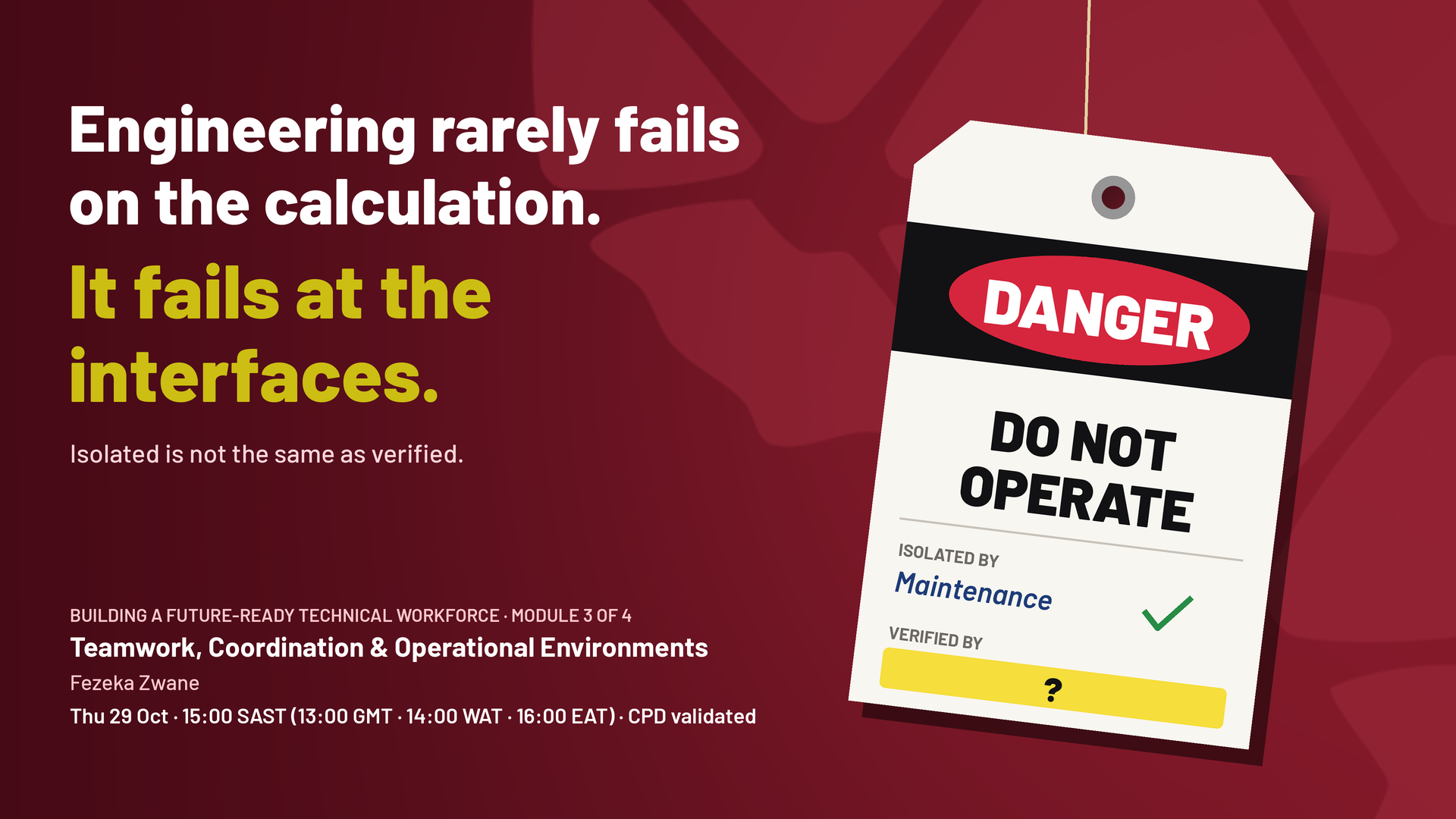
Engineering Workplace Readiness: Teamwork, Coordination & Operational Environments
Module 3 of 4 · Building a Future-Ready Technical Workforce Technical mastery is the baseline. Operational integration is the deliverable. A shutdown starts. Maintenance hasn't confirmed the equipment is ready. Contractors begin before isolation is verified. Nobody lacked technical knowledge; the team failed to work as a system. Module 3 of Building a Future-Ready Technical Workforce moves readiness from the individual to the team, through three simulations: a maintenance shutdown, a team root-cause problem, and a schedule that keeps operations running while project milestones land. What you'll learn: - Work in a multidisciplinary team with defined roles and RACI accountability, so handovers don't fall through the gaps. - Plan and coordinate tasks, including a shutdown schedule, under pressure and tight deadlines. - Adapt how you communicate and decide in project and operational settings, and raise risks before they become delays or safety incidents. Thursday 29 October 2026: 13:00 GMT, 14:00 WAT, 15:00 SAST, 16:00 EAT. 120 minutes with Q&A. CPD validated, live or on demand, certificate on completion. Create your free account, or log in, and book your seat.

Foundations: Asset Management Philosophy & the ISO 55000 Suite - Clause 5
Your asset management system isn’t failing because of the SCADA platform. A decade of ISO 55001 implementations points to one variable above all others: leadership. Every requirement in Clause 5 opens with the same two words — top management shall. The repetition is deliberate. Engineers and maintenance teams can support an asset management system; they cannot own it. Where ownership is unclear, the policy sits on a shelf, the asset register stays incomplete for want of people to maintain it, and a plant manager carries responsibility with no authority to act on it. Module 2 takes Clause 5 apart. It covers the ten leadership obligations of 5.1 and what genuine commitment looks like in evidence rather than intent; the five requirements of an asset management policy under 5.2, with a side-by-side of a policy that anchors to nothing versus one that names its purpose, its legislation and its licence conditions; and the responsibility / authority / accountability distinction under 5.3, including the two assignments top management must formally make to named individuals. It closes by tracing a single unbroken line of sight from a boardroom commitment to a contractor arriving on site in 90 minutes. Module Number: Module 2 Duration: 2 Hours (Facilitated workshop with case studies, including interactive Q&A) By the end of this module, you’ll be able to: Explain why Clause 5 places accountability for the AMS with top management, and describe the ten leadership obligations it imposes. Test an asset management policy against the five requirements of Clause 5.2 — and judge whether it is actually known in the field or only on file. Distinguish responsibility, authority and accountability under Clause 5.3, and make the two mandatory assignments without creating the most common governance failure. This module is CPD Validated, live or on demand. A certificate is issued on completion.
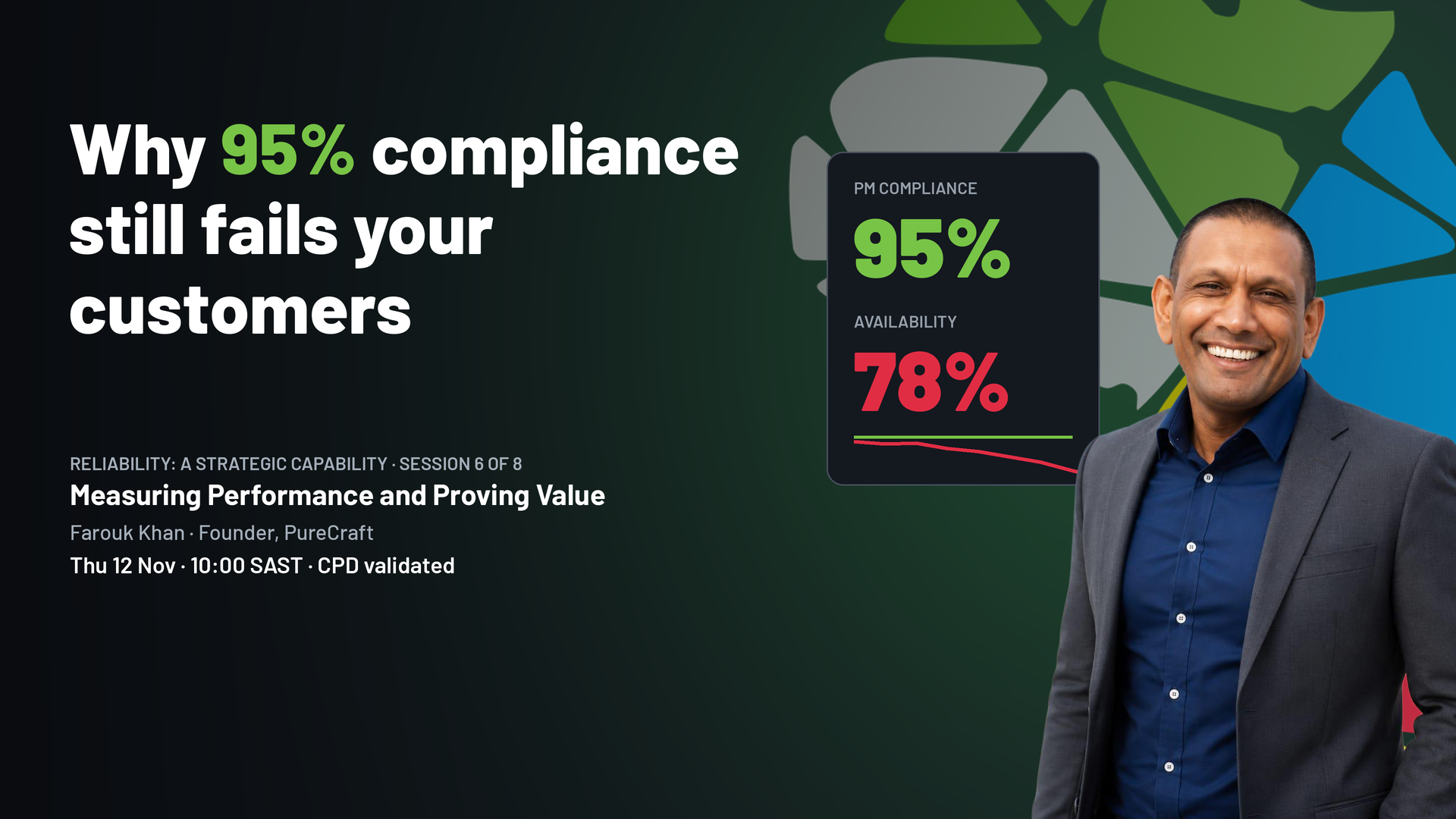
Measuring Performance and Proving Value
Session 6 of 8 · Reliability: A Strategic Capability If every dashboard is green while asset availability keeps falling, the problem is not reporting. It is what the organisation has chosen to measure. Session 6 connects customer demand to the performance of the assets expected to deliver it, using standard measures for Availability, MTBF, OEE and Quality, and the drill-down that finds the asset behind a company-wide shortfall. What you'll learn - Calculate and interpret the operational KPIs that matter. - Balance leading indicators such as planning and readiness with lagging outcomes such as downtime and missed demand. - Show leadership where performance is being lost and what needs attention first. Presenter: Farouk Khan, Founder of PureCraft. When: Thursday 12 November 2026, 10:00 to 12:00 SAST (08:00 GMT, 09:00 WAT, 11:00 EAT). Two hours, discussion-led, with Q&A. CPD: CPD validated, live or on demand, certificate on completion Create your free account, or log in, and book your seat.
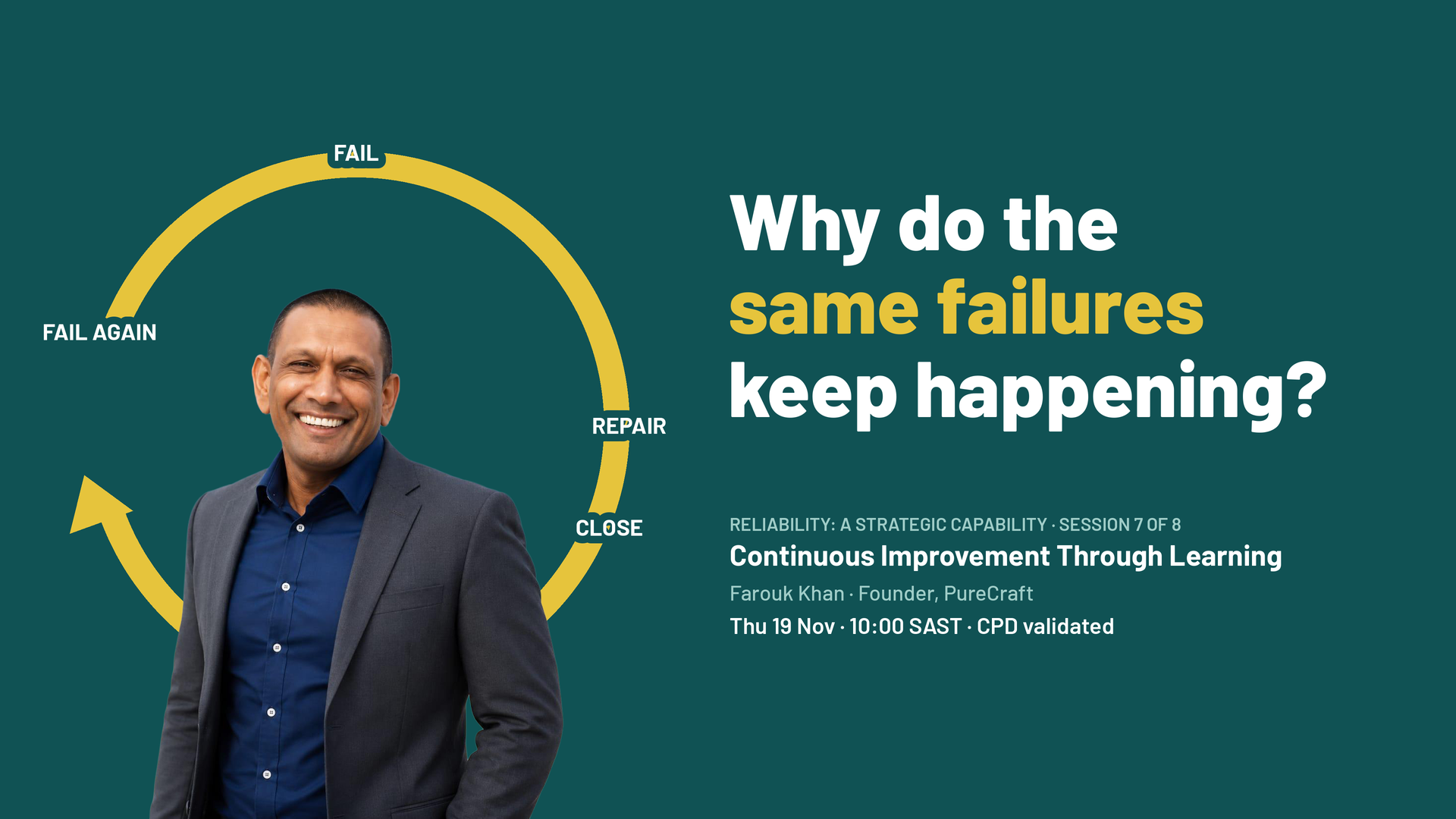
Continuous Improvement Through Learning
Continuous Improvement Through Learning Session 7 of 8 · Reliability: A Strategic Capability Closing a work order is not the same as fixing the failure. If the repair is never verified, the same loss can return under a different ticket. Session 7 shows maintenance and reliability leaders how to close the learning loop after failures, warning signs and completed work. What you'll learn: - Decide when a failure needs a full investigation or a rapid team review, using risk-proportional RCA triggers. - Classify failure modes the same way across the fleet, to expose recurring losses hidden across assets. - Confirm that the fix restored the required capacity before the job is closed. Presenter: Farouk Khan, Founder of PureCraft. Thursday 19 November 2026, 10:00 to 12:00 SAST (08:00 GMT, 09:00 WAT, 11:00 EAT). Two hours, discussion-led, with Q&A. CPD validated, live or on demand, certificate on completion. Create your free account, or log in, and book your seat.
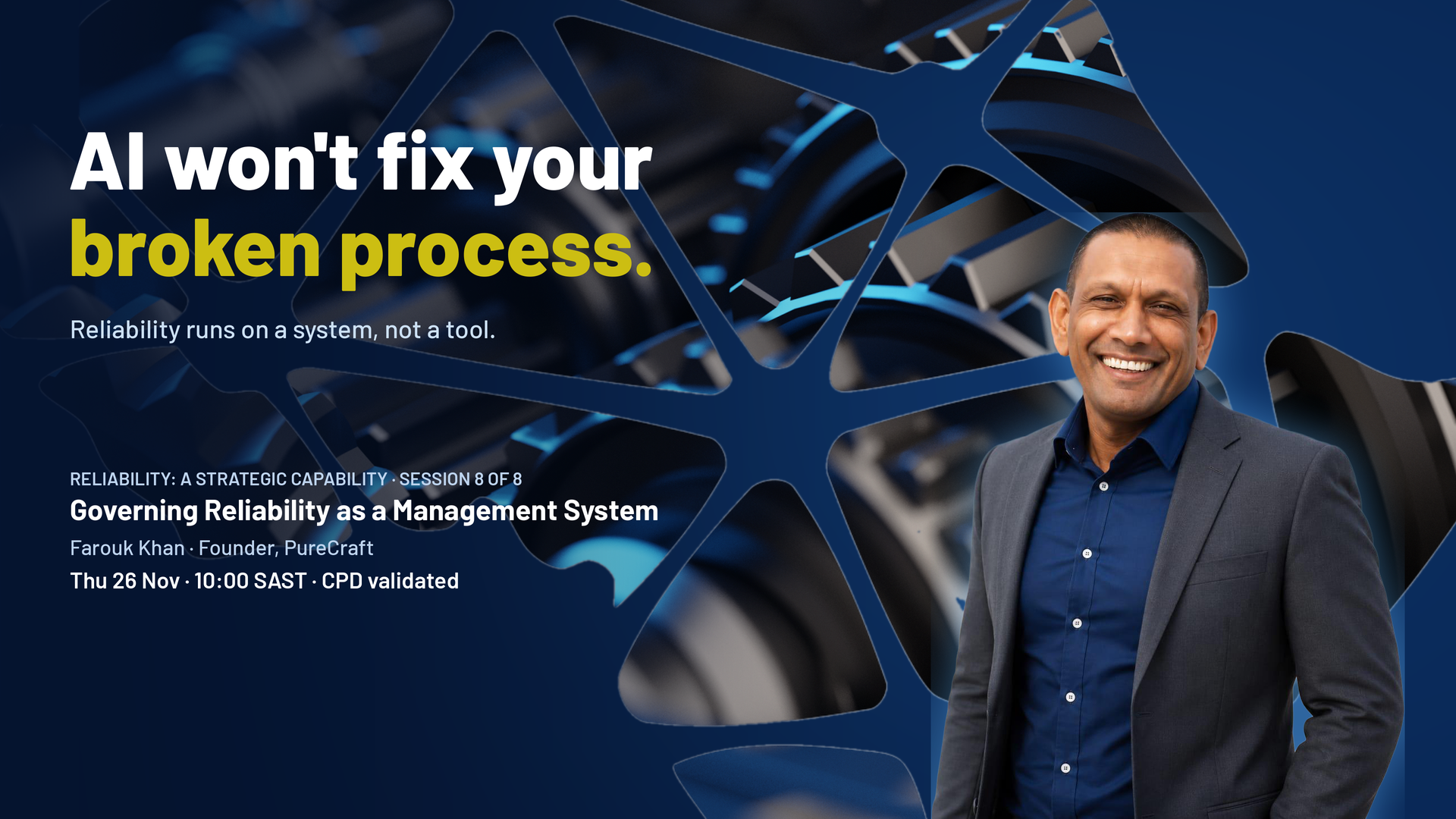
Governing Reliability as a Management System
Governing Reliability as a Management System Session 8 of 8 · Reliability: A Strategic Capability Seven reliability initiatives competing for the same budget will not create a reliable service. They need one management system. The final session of the series brings it together: a decision-focused review, an eight-view management report, cross-functional accountability, and a clear view of where AI adds value without weakening human oversight. Built for leaders responsible for service performance, asset reliability and transformation governance. What you'll learn: - Integrate the eight reliability building blocks into one governed system. - Trace customer demand to accountable asset owners. - Assess your organisation's readiness for responsible automated analytics. Presenter: Farouk Khan, Founder of PureCraft. Thursday 26 November 2026, 10:00 to 12:00 SAST (08:00 GMT, 09:00 WAT, 11:00 EAT). Two hours, discussion-led, with Q&A. CPD validated, live or on demand, certificate on completion. Create your free account, or log in, and book your seat.
Manufacturing & Industrial Systems
Selecting the Right Maintenance Tactic for Every Asset
Session 5 of 8 · Reliability: A Strategic Capability Choosing a maintenance tactic by gut feel, or "how we've always done it", is how good budgets fund the wrong fixes. Session 5 shows how asset behaviour (static or dynamic) and specific failure mechanisms should decide your tactic, so you can say exactly why each asset gets the one it gets. What you'll learn: - Differentiate maintenance approaches for static containment assets and dynamic functional machinery. - Apply objective decision triggers to choose between RCM, PMO, RBI, RCA and CBM. - Turn condition-monitoring signals into owner-assigned, timely, controlled interventions, not alerts that get ignored. Presenter: Farouk Khan, Founder of PureCraft. When: Thursday 29 October 2026, 10:00 to 12:00 SAST (08:00 GMT, 09:00 WAT, 11:00 EAT). Two hours, discussion-led, with Q&A. CPD validated, live or on demand, certificate on completion. Create your free account, or log in, and book your seat.
Measuring Performance and Proving Value
Session 6 of 8 · Reliability: A Strategic Capability If every dashboard is green while asset availability keeps falling, the problem is not reporting. It is what the organisation has chosen to measure. Session 6 connects customer demand to the performance of the assets expected to deliver it, using standard measures for Availability, MTBF, OEE and Quality, and the drill-down that finds the asset behind a company-wide shortfall. What you'll learn - Calculate and interpret the operational KPIs that matter. - Balance leading indicators such as planning and readiness with lagging outcomes such as downtime and missed demand. - Show leadership where performance is being lost and what needs attention first. Presenter: Farouk Khan, Founder of PureCraft. When: Thursday 12 November 2026, 10:00 to 12:00 SAST (08:00 GMT, 09:00 WAT, 11:00 EAT). Two hours, discussion-led, with Q&A. CPD: CPD validated, live or on demand, certificate on completion Create your free account, or log in, and book your seat.
Continuous Improvement Through Learning
Continuous Improvement Through Learning Session 7 of 8 · Reliability: A Strategic Capability Closing a work order is not the same as fixing the failure. If the repair is never verified, the same loss can return under a different ticket. Session 7 shows maintenance and reliability leaders how to close the learning loop after failures, warning signs and completed work. What you'll learn: - Decide when a failure needs a full investigation or a rapid team review, using risk-proportional RCA triggers. - Classify failure modes the same way across the fleet, to expose recurring losses hidden across assets. - Confirm that the fix restored the required capacity before the job is closed. Presenter: Farouk Khan, Founder of PureCraft. Thursday 19 November 2026, 10:00 to 12:00 SAST (08:00 GMT, 09:00 WAT, 11:00 EAT). Two hours, discussion-led, with Q&A. CPD validated, live or on demand, certificate on completion. Create your free account, or log in, and book your seat.
Governing Reliability as a Management System
Governing Reliability as a Management System Session 8 of 8 · Reliability: A Strategic Capability Seven reliability initiatives competing for the same budget will not create a reliable service. They need one management system. The final session of the series brings it together: a decision-focused review, an eight-view management report, cross-functional accountability, and a clear view of where AI adds value without weakening human oversight. Built for leaders responsible for service performance, asset reliability and transformation governance. What you'll learn: - Integrate the eight reliability building blocks into one governed system. - Trace customer demand to accountable asset owners. - Assess your organisation's readiness for responsible automated analytics. Presenter: Farouk Khan, Founder of PureCraft. Thursday 26 November 2026, 10:00 to 12:00 SAST (08:00 GMT, 09:00 WAT, 11:00 EAT). Two hours, discussion-led, with Q&A. CPD validated, live or on demand, certificate on completion. Create your free account, or log in, and book your seat.
Professional Practice, Ethics & Compliance
Foundations: Asset Management Philosophy & the ISO 55000 Suite - Clause 5
Your asset management system isn’t failing because of the SCADA platform. A decade of ISO 55001 implementations points to one variable above all others: leadership. Every requirement in Clause 5 opens with the same two words — top management shall. The repetition is deliberate. Engineers and maintenance teams can support an asset management system; they cannot own it. Where ownership is unclear, the policy sits on a shelf, the asset register stays incomplete for want of people to maintain it, and a plant manager carries responsibility with no authority to act on it. Module 2 takes Clause 5 apart. It covers the ten leadership obligations of 5.1 and what genuine commitment looks like in evidence rather than intent; the five requirements of an asset management policy under 5.2, with a side-by-side of a policy that anchors to nothing versus one that names its purpose, its legislation and its licence conditions; and the responsibility / authority / accountability distinction under 5.3, including the two assignments top management must formally make to named individuals. It closes by tracing a single unbroken line of sight from a boardroom commitment to a contractor arriving on site in 90 minutes. Module Number: Module 2 Duration: 2 Hours (Facilitated workshop with case studies, including interactive Q&A) By the end of this module, you’ll be able to: Explain why Clause 5 places accountability for the AMS with top management, and describe the ten leadership obligations it imposes. Test an asset management policy against the five requirements of Clause 5.2 — and judge whether it is actually known in the field or only on file. Distinguish responsibility, authority and accountability under Clause 5.3, and make the two mandatory assignments without creating the most common governance failure. This module is CPD Validated, live or on demand. A certificate is issued on completion.
Leadership, Management & Business
Engineering Workplace Readiness: Teamwork, Coordination & Operational Environments
Module 3 of 4 · Building a Future-Ready Technical Workforce Technical mastery is the baseline. Operational integration is the deliverable. A shutdown starts. Maintenance hasn't confirmed the equipment is ready. Contractors begin before isolation is verified. Nobody lacked technical knowledge; the team failed to work as a system. Module 3 of Building a Future-Ready Technical Workforce moves readiness from the individual to the team, through three simulations: a maintenance shutdown, a team root-cause problem, and a schedule that keeps operations running while project milestones land. What you'll learn: - Work in a multidisciplinary team with defined roles and RACI accountability, so handovers don't fall through the gaps. - Plan and coordinate tasks, including a shutdown schedule, under pressure and tight deadlines. - Adapt how you communicate and decide in project and operational settings, and raise risks before they become delays or safety incidents. Thursday 29 October 2026: 13:00 GMT, 14:00 WAT, 15:00 SAST, 16:00 EAT. 120 minutes with Q&A. CPD validated, live or on demand, certificate on completion. Create your free account, or log in, and book your seat.
Past Events
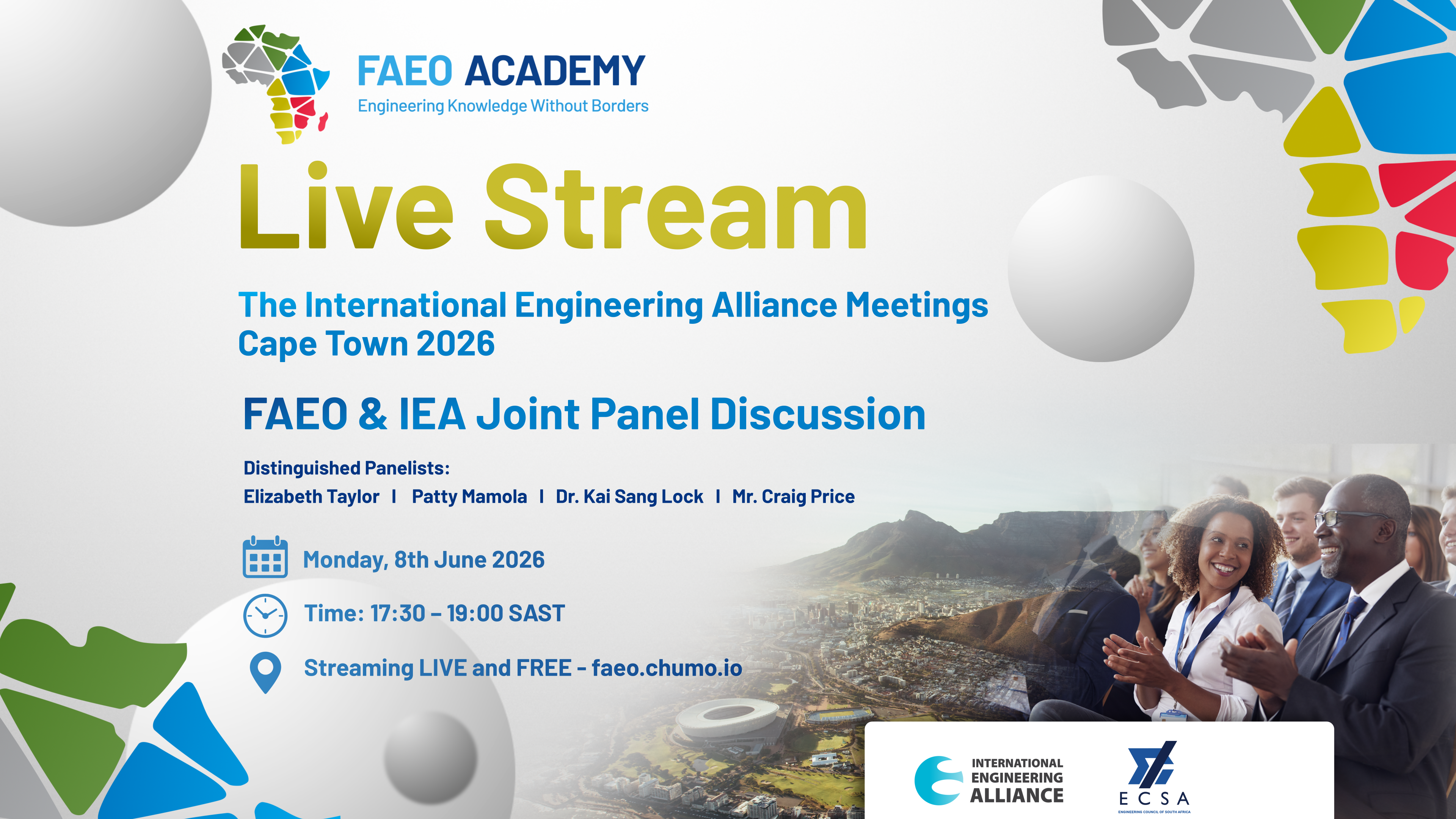
The International Engineering Alliance Meetings 2026: FAEO & IEA Joint Panel Discussion
"Engineering careers increasingly cross borders. The standards that make qualifications and professional competence recognisable across those borders matter to institutions, employers and individual engineers. At the International Engineering Alliance Meetings 2026, FAEO and the IEA bring global leaders together for a joint panel on engineering excellence and professional mobility. Hear directly from the organisations shaping international recognition and explore what changing standards, accords and mobility pathways mean for African engineering institutions and professionals. Designed for regulators, professional bodies, education leaders, employers and engineers who want a clearer view of how international recognition affects qualifications, registration and career opportunity. Access the panel and hear how global recognition is shaping engineering mobility."
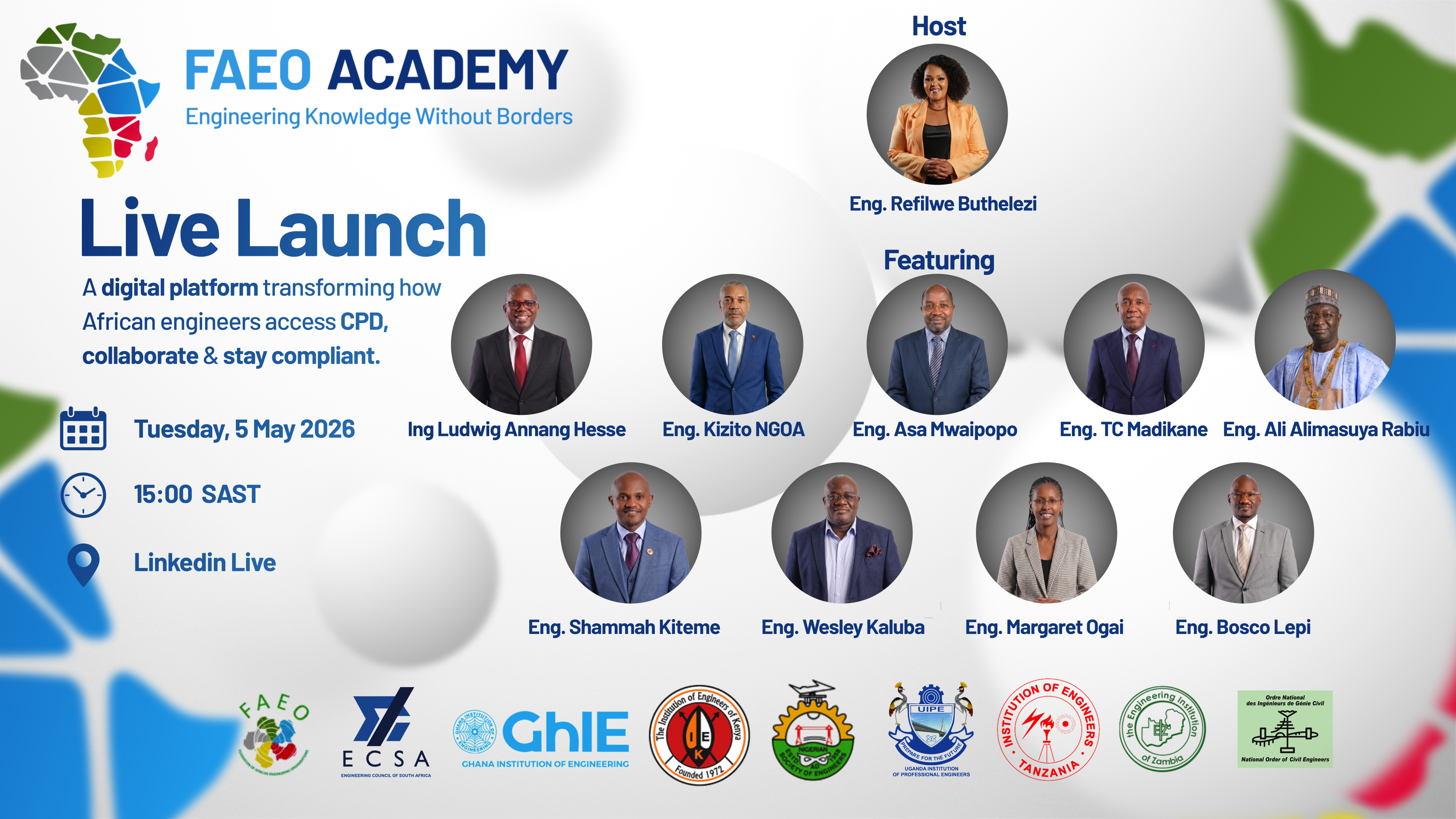
FAEO ACADEMY Live Launch
See the FAEO Academy open its doors to engineers across Africa. Hosted by FAEO President Refilwe Buthelezi, the live launch brings together Presidents and CEOs from Founding Member Institutions in one continental broadcast. Discover how the platform is designed to expand access to Continuing Professional Development, support collaboration across institutions and help engineers stay current with professional requirements. The launch is for engineers, member institutions, employers and partners who want a first look at the Academy, the community behind it and the opportunities it creates for learning across borders. Watch the launch and take your first step into the FAEO Academy.